|
Portland YWCA
Buildings
Document
1
Document
2
Early
Efforts
Mid-Century
Growth
Recent
Changes
|
How Did the Portland YWCA Carry out the National Organization's
Mandate that Housing and Shelter Be "the very foundation of YWCA services?"[1]
Research
by Marlene St. Onge, Sandra Dixon, and Ismoon Hunter-Morton

Female-only
space carried great import for the YWCA's social and evangelical mission.
Buildings allowed for the protection of women and girls from the vagaries
of social dislocation and economic change. Buildings and meeting space
helped YWCA leaders to gather women together in order to spread the
Gospel across lines of age, class, and neighborhood, thus fulfilling
its role as "handmaid of the church." The Portland YWCA, like other
YWCAs all over the country, created a home-like environment without
men from which to exercise authority in the public sphere in an era
of restrictions on female citizenship and mobility.
The
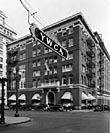
Portland association began by renting rooms at SW Oak and Sixth Avenue
in the downtown business district. This suite included offices, classrooms,
and parlors, some of which were converted to dormitory use when need
arose. The success of this venture inspired the opening of a tearoom
and cafeteria in the Wortman, Olds & Kings department store. These
eateries enabled outreach to a key constituency, young white women who
were employed in the store and in other nearby shops. It also provided
a training ground for the YWCA's students in cooking and domestic science.
Finally, it created much needed income for the organization. Because
of legal restrictions on married women's ability to own property or
negotiate legal instruments, the early board of directors required assistance
from a white male "board of trustees" who, as fully enfranchised male
citizens, were empowered to sign checks and negotiate contracts on behalf
of the YWCA.
 |
|
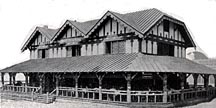
Lewis
& Clark Exposition, 1905
|
The
YWCA board next sought to extend its protective embrace over women at
the Lewis and Clark Exposition held in Portland in 1905. Supported by
the Travelers' Aid society, the YWCA purchased land at the Exposition
site in order to construct a "Headquarters" building. Their goal was outreach
to employed women, recruitment of potential YWCA members, and oversight
of the moral tone of the dance halls and beer gardens on the fair grounds.
They held luncheons, worship services, musicales, and lectures. The money
raised from the Fair provided seed funds for the construction of a permanent
YWCA building downtown.
Thus
began a pattern of construction that would, over the course of the century,
touch most of the sections of the city of Portland. North Portland,
an historically white working-class section, Northeast, which became
coded "black" in the early twentieth century, and downtown, located
in the wealthy Southwest, all received attention from the YWCA. Southeast
remained outside the organization's purview, stigmatized for its mixed-class,
ethnic, racial, and bohemian composition, despite the presence of the
toney Westmoreland neighborhood around Reed College. Comments of a board
member as late as 1968 typify this bias against the neighborhood as
a haven for "hippies, a Spanish-speaking community, fatherless homes,
drug availability" as well as "communists" and "lesbians."[2]
1.
Elsie D. Harper, The Past is Prelude: Fifty Years of Social Action
in the YWCA (New York: YWCA, 1963), p. 37.
Back
to Text
2.
Executive Committee Meeting Minutes, 14 October 1968, Portland YWCA
Archives, Portland, Oregon.
Back
to Text
| YWCA
Today | Programs | African-American
Women |
| Asian-American Women | World
War II | Religion, Race, & Reform |
Camping |
|